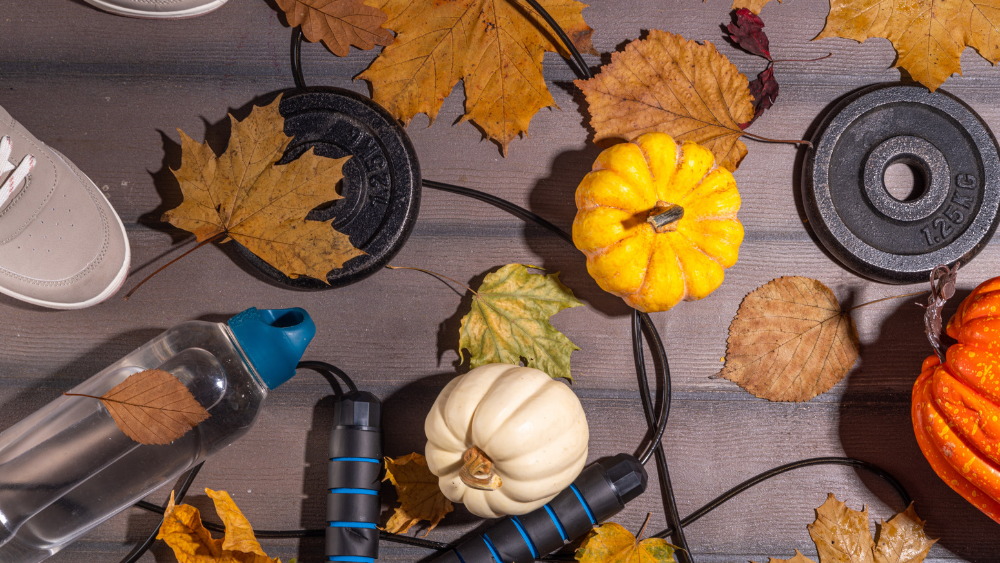
Have you been making great progress in your healthy lifestyle journey, but now feel accosted by the holidays? Halloween? Impending Thanksgiving? Future plans of travel, parties, and family events for Christmas? Does it feel like it will be impossible to maintain your trajectory for the next two months? Just yesterday, I had a great coaching conversation with a client about how to handle the roller coaster of the holiday season when you’re trying to lose weight, and I want to share a few takeaways with you – 5 tips for handling the holidays (especially when you’re losing weight).
5 Tips for Handling the Holidays
Tip 1: Keep perspective
Before I had my daughter, I wrote a blog post several years ago about “holidays vs. holimonths.” The principle still stands, but now that our family has grown, I better appreciate the nonstop intrusion of candy and parties that I didn’t experience before. Previously, I would have said that there are 2-3 true days of celebration in the holiday season – now I understand that there could be as many as 10-14 unusual food days in November and December when you have children. For example, it is only November 1, and we have had five Halloween/fall events already (and we only have one kid).
But… even if we say 10-14 days, that’s still only 10-14 days. I would still advise keeping holidays and special events in perspective, trying to have as many “normal” days as possible in between the weird ones – keeping in mind that even if there are 14 celebrations, there are still 46 other days. And on a micro-level, even on special days, it is likely that some meals are still normal throughout the rest of the day.
In other words, don’t take the entire two months “off.”
Tip 2: Be smart about your environment
The client who I chatted with yesterday is going to Disney for two weeks, and she is planning to order Instacart for their hotel room so they have plenty of healthy food for snacks, and they also don’t have to dine out for every meal.
She is being smart about her food environment.
“Food environment” is a jargon-y term for food context – what your food world is like. Food environment includes everything from how you shop for groceries to how you meal prep to how you organize your kitchen.
During the holidays, food environment is something to pay special attention to. For example…
- Do you keep candy around the house (and visible) throughout the Halloween season?
- Do you make oversized treats for parties and then keep the leftovers?
- Do you leave tempting, indulgent foods out on the kitchen counters or front-and-center in the refrigerator?
- Do people bring you or gift you lots of treats?
- Do you neglect regular shopping and meal prepping when big events are coming up?
By ordering Instacart for her hotel room, my client is taking healthy control of her food environment, so that she isn’t overly dependent on convenience food and restaurants. Small steps like this really count! In a similar vein, I would advise:
- Ordering or buying groceries if you’re having an extended stay at a relative’s home
- Throwing away or giving away extra food and leftovers (including Halloween candy)
- Making sincere attempts not to excessively over-prepare food (i.e., making dinner for 20… for five people)
- Continuing to shop and meal prep as usual, even when there are lots of parties and gatherings
- Storing tempting, indulgent treats in opaque containers in hard-to-see places (i.e., a high shelf, or the back of the bottom shelf of the refrigerator)
Food environment is incredibly powerful, since we tend to respond to visual cues (when we see something, we want it). By making small, strategic moves to tailor your food environment to your health goals, you set yourself up for success!
Tip 3: Embrace the difference between meaningful enjoyment and mindless overconsumption
As I tell my clients, there’s a huge difference between enjoying a treat that’s a true favorite, and just eating something because it’s there.
Because November and December tend to be pretty saturated food environments, it’s easy to overeat. A lot of food is just… there. Hyperpalatable foods have strong eating cues/triggers, and it’s smart to be mindful about emphasizing the favorite food traditions that you really love… or else overconsumption can end up being indiscriminate and regretful.
My Halloween example is that I love Reese’s Peanut Butter Cups! I always egg on my daughter to grab at least a few of them when she’s trick-or-treating (and she knows they’re for me!). But I don’t also eat the other candies that I’m not as jazzed about. I also don’t buy an entire bag of Reese’s, because even though I enjoy them, I don’t think I would enjoy them as mindfully if I had 100 of them.
The key is to dial into presence and enjoyment – really relishing something that you love, and stopping when you hit that “enough” factor. By following Tip 2 and being responsible about your food environment (i.e., not buying 100 Reese’s), it’s easy to stop.
The same goes for other holidays – do you enjoy something three times as much if you have three servings? Probably not. Do you truly enjoy a food that you eat mindlessly while you’re watching a football game? Also probably not. Eat the foods you really love, pay attention while you’re doing it, and skip on the things that you don’t love.
Tip 4: Relax timelines
At the same time that you put “protections” in place to keep supporting healthy habits over the holiday period, you might also consider a break from your weight loss timeline for a few months.
Plateaus are frustrating when they happen by accident, but empowering when they’re engineered on purpose.
Here’s a mental reframe for you: what happens long-term when you stop losing weight – when you reach an ideal, natural weight for your body? It’s a plateau, right? This “forever plateau” is called maintenance. And the reality is that most people are not very good at maintaining lost weight – they tend to regain. So if you spend two months over the holidays getting good at maintenance, you building your skill toolbox for maintaining weight loss, which is the real goal. When it’s on purpose, you’re not in a plateau – you’re in maintenance mode, and strengthening your long-term skills.
The problem is that, as a society, we have a very black-and-white perspective on weight. Either you’re trying to lose weight, or you’re giving up and gong back to the unhealthy habits that led to problems in the first place. Getting good at maintenance breaks this cycle. Maintenance mode does not mean that you’re giving up or hitting pause for two months – you continue to be engaged with your health goals, but just at slightly higher calories. You’re not just maintaining your weight – you’re maintaining your healthy routines, but also including some extra parties and gatherings.
You don’t have to be in a calorie deficit to be living a healthy lifestyle!
When we apply this all-or-nothing thinking to other areas, it really helps to visualize what you’re doing to your body. Let’s say you own a house. Weight loss would be the equivalent of renovating. We can’t be renovating all the time, because no one has the time or money to constantly focus on endless improvement and effort. But even when we’re busy or stressed, we need to do things regularly to keep the house in working order – clean it, fix or replace things that break, keep pests at bay, and treat systems properly. This is called “maintaining” the house. Otherwise, we run into big problems, and the house gradually deteriorates into a tear-down disaster.
With a house, we clearly see the difference between the extremes. Just because we’re not buying a new toilet doesn’t mean we flush toys or wipes down the existing toilet. But we do this our bodies – if we’re not trying to lose weight, it’s easy to let routines and safeguards fall apart. But when we think of “maintaining” as “caring,” it helps us see things like exercise and healthy eating as part of self-care, not necessarily limited to weight loss efforts. It’s such a powerful reframe.
Maintenance modes are even more impactful when you follow Tip 5, too…
Tip 5: Utilize maintenance periods to focus on exercise performance
Dieting can be a lot of cognitive and logistical effort. So if you’re not actively in a calorie deficit, where do you redirect that energy to best effect?
My advice is to focus on exercise consistency and performance during maintenance periods. Set yourself a goal that is not weight-loss related – run a 5K faster, deadlift heavier, or increase your pull-up count. Maybe you are eating a little more, but you’re coaching your body to direct the extra calories to muscle and speed.
These goals are incredibly empowering! They’re not just good for mental health (which they are) – they’re also taking advantage of the fact that your body actually functions more optimally at maintenance calories than it does in a calorie deficit.
Read that again… your body functions better when you are not in a caloric deficit.
When you’re not restricting calories as part of the weight loss process, your body effective “fires back up” and becomes more efficient and muscle gain and – surprisingly – fat loss. So if you really lean into exercise efforts even when you can’t “diet,” you’ll be surprised to see that even if you don’t lose weight, you may experience improvements in body composition. In other words, you might get leaner, even if you don’t get lighter. And you’ll feel better, too!
This effect is even more pronounced in leaner people who are trying to get leaner, since the calorie levels required to lose weight tend to be more punishing and restrictive for smaller people with less body fat. Allowing yourself to float back up to 1800 calories from 1400 calories can give your body the fuel it needs to get hormones back to optimal levels. This means that, when you’re in maintenance mode, you can actually make greater gains on your fitness goals, which tends to translate into an improved body composition.
But for anyone, regardless of health status, the psychological benefit of creating one or two exercise goals during the holidays is that it keeps you in a healthier frame of mind overall, keeping self-care habits front and center (and keeping you out of “give up” mode). If you struggle with your weight, having a tangible goal for your exercise can provide valuable momentum during the holidays, so that you don’t feel directionless without a weight loss goal.
I hope these 5 tips for handling the holidays were helpful to you! If you want to set up a free 30-minute consultation to talk about your goals, schedule it here!