The Intelligent Way to Work Out for Weight Loss
In some ways, I don’t even know where to start with this blog post – not only because the topic can be incredibly complex (which it is), but because of the vast swamp of misinformation on the internet.
One of the most harmful, pervasive myths is actually a twofer, expressed in two extremes: that exercise will burn tons and calories and help significantly with weight loss, or on the flip side, that it will not help at all (so you shouldn’t even bother and just focus on diet instead).
Neither of this extremes are true. The reality is that if you construct (and, importantly, follow) an intelligent exercise program as part of a healthy lifestyle change, you will experience better weight loss than if you don’t. Research (like this meta-analysis) demonstrates that a combination of physical activity and diet are more effective than either exercise or nutrition alone.
So in today’s blog post, I’m sharing the “levels” that I encourage clients to really focus on for exercise and weight loss. It’s helpful to envision an exercise program like a pyramid, with a bigger base and a smaller top. The size of the level (whether it’s the big foundation or the tiny peak) indicates how much volume/time you should spend each week doing each kind of exercise for optimal weight loss results.
The good news is that when you think of exercise needs like a pyramid, it becomes less overwhelming, because you don’t need to spend all day, every day at the gym (or train for a marathon). You just need to make sure that you’re prioritizing the right kinds of exercise in the right amounts, and you’ll healthfully support your weight loss efforts in the long run.
The Pyramid of Exercise for Health and Weight Loss
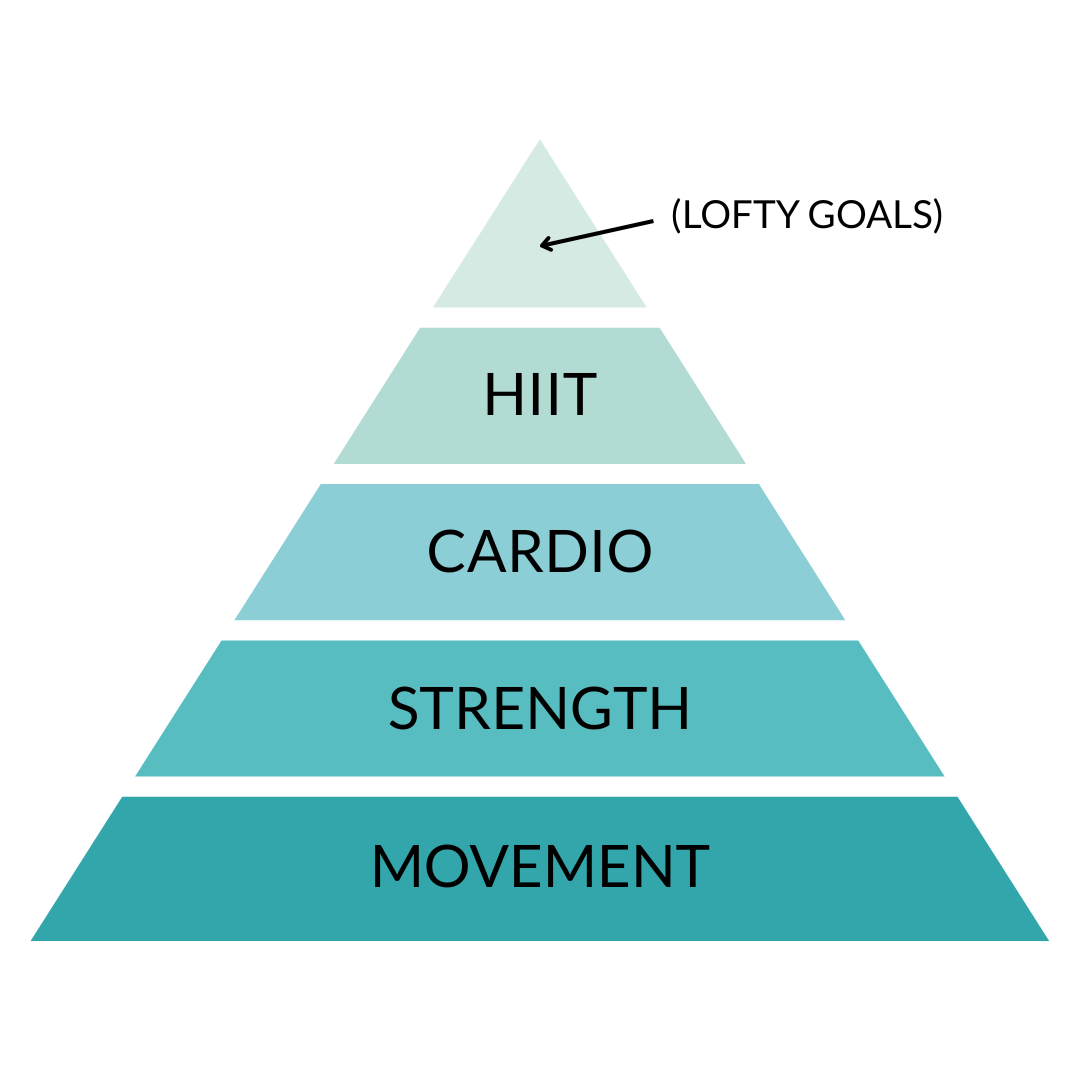
Level 1 (The Foundation): Movement
Remember, we’re zooming in on the bottom of the pyramid first, because this represents the type of exercise in which you should invest most of your time. For weight loss, your prime focus should be on movement.
Another word for movement is “NEAT” – non-exercise activity thermogenesis. This type of informal, organic “exercise” isn’t really exercise, per se. You might do more of it once you’re focused on losing weight, but honestly it’s just a healthy lifestyle habit. For example, if you do not currently get 150 minutes of moderate movement per week (think walking, fun biking, gardening, swimming with your kids, etc.), that’s the first thing that will make a tremendous difference to your weight loss efforts.
The reasons that NEAT is so impactful are many – when people are more active, their mental health tends to be better, as well as their insulin sensitivity and their sleep (all of which contribute to a healthier, more controlled diet). Plus, there’s research that suggests that getting about 7,000 steps per day helps to reduce cravings and regulate appetite.
But when it comes down to math, NEAT simply burns a lot of calories relative to effort. For example, 10,000 steps per day burns about 200-500 calories pretty painlessly for most people. If you hopped on a treadmill for a run intending to burn 200-500 calories, perceived effort would be much higher. And the problem is that when people feel they’ve worked hard at exercise, there can be a tendency to sort of “take off’ for the rest of the day, and perhaps eat more, as well.
NEAT is wonderful because it is not stressful to the body – you can do it in large amounts without feeling burned out or overly hungry, and – again – it also has positive effects on physical and mental health that are hard to quantify. So for the foundation of our pyramid, we want to be focusing on getting at least 150 minutes per week of moderate intensity exercise (and, psst… even more can be better for weight loss specifically).
Low intensity, high volume!
Level 2: Strength Training
Strength training doesn’t burn a lot of calories, so this leads to the (incorrect) assumption that you should focus more on cardio when you’re trying to lose weight.
But the truth is that if you don’t strength train during a weight loss journey, you’re leaving results on the table! If the foundation of your weekly exercise routine is lots of organic movement, then the next level is 2-4 sessions of high-quality muscle-strengthening exercise.
With strength training, don’t fall into the trap of either going too easy (nothing but bicep curls and triceps kickbacks) or too ridiculously bootcampy (burpees). Focus instead on stable, metabolically-demanding exercises that stress out your muscles – “compound” movements with big ranges of motion like squats, lunges, and other multi-joint exercises. These movements are incredibly effective for building muscle and encouraging your body to divert more calories into muscle gain.
After good strength workouts, you might feel a little wobbly but not overly fatigued or sweaty, and that’s okay. The point of strength workouts isn’t to burn calories – it’s to build muscle. If you lose weight without strength training, about 20%-30% of your weight loss is muscle. But if you incorporate a solid resistance training plan into your lifestyle, you may actually gain muscle while losing weight, which is extremely helpful for your metabolism (i.e., keeping weight off).
But it’s not only metabolically helpful – it genuinely makes a difference in how you look and feel, too!
Quick detour: The most common question I get about strength training is if classes like Pilates or yoga count. The answer is a careful “yes”… with the addendum that you will probably get better results if you balance your exercise portfolio between some Pilates/yoga and some traditional resistance training (i.e., two sessions per week of each). In my experience, I simply don’t see my clients get the best results if they only do Pilates and yoga – it’s often just not enough stimulus to get the muscles to really respond.
The takeaway? If you have a good foundation of NEAT, you can make great progress with just a few sessions per week of solid strength training, even if you do nothing else higher on the pyramid!
Level 3: Endurance Cardio
I would call this “higher intensity” cardio, vs. true “HIIT” (high-intensity interval training), which we’ll discuss next. If I were using heart rate ranges to distinguish NEAT from endurance cardio from HIIT, this is how it would look:
- NEAT: 60%-70% of HR max
- Endurance cardio: 70%-80% of HR max
- HIIT: ups and downs with spikes to 80%-90% or even a little higher
Endurance cardio is hard, but not unsustainable. You can maintain the pace even though it’s uncomfortable. You’re sweating and your heart is pounding, but you’re not ready to vomit.
Cardio is incredibly impactful for heart and lung health, and it also burns calories very quickly. However, the myth of “cardio for weight loss” is twofold: it doesn’t burn as many calories as people think (because calorie burn estimators are almost always wrong, even on smart watches), and it tends to stoke hunger more than people realize.
This is why it is a little higher up on the pyramid… I don’t advise using lots and lots of cardio to try to lose weight, as this is a strategy that can truly backfire. Not only are you more prone to injury if you overuse cardio as a weight loss strategy, but you may just not see the results you want. I have had dozens of clients prepare for half-marathons and a few for full marathons, and because of the nutrition requirements of high-volume cardio, it’s desperately difficult to stay in a deficit while training (and it’s not worth trying). In fact, it is not uncommon to gain weight while preparing for a race.
So if you’re dependent on cardio to feel like you’re working hard enough to lose weight… it’s time to break that connection in your brain. It’s not effective, and potentially harmful. You only need a few sessions per week of really hard cardio to support optimal cardiovascular health, get a boost of endorphins, and improve your overall endurance and mental toughness.
Level 4: HIIT
This is very nearly the cherry on top, because so little of it is needed (and not everybody should do it, at least not right away). Only about 10% of your total exercise output can – or should – be true “HIIT” (high-intensity interval training). This means possibly just 1-2 HIIT sessions a week of about 12-20 minutes max.
Of course, many classes are called “HIIT” that are actually just endurance cardio dressed up as running, rowing, or weightlifting intervals. How can you tell the difference?
If we go back to those heart rate ranges, true HIIT (80%-90% of HR max or higher) can only be performed for about 20-30 seconds before… well, pretty much complete collapse. Not one minute, or 90 seconds, or two minutes – literally just 20-30 seconds and you must stop before you fall down or start getting unbearably nauseous.
A good example of a HIIT workout is treadmill sprints – 20-30 seconds at an almost-unmanageable speed, followed by complete rest for 60-90 seconds. Rinse and repeat 8-10 times. You can do this on any cardio machine, whether it’s rowing, cycling, the Assault bike, or any other cardio.
Let me be clear: HIIT is amazing exercise, and it does have some incredible fat-burning properties. But the major caveat here is that very few people can actually do HIIT. It’s a fitness issue – if you can’t do basic fast running for an extended period of time, you shouldn’t try super-fast running as a way to cheat the system. It’s not a shortcut. You have to walk before you run, and run before you sprint.
But – on the flip side – if you are in good shape and don’t do any HIIT, you should do it! Just make sure to do it safely – not when you’re already completely exhausted, and not with exercises that require a high level of coordination (like jumps). You might be surprised at how much 1-2 short sessions a week boosts your fat loss progress.
If you’re interested in learning more about HIIT, check out this episode of Jordan Syatt’s podcast with Alex Viada – it’s a great listen!
Level 5: Lofty Goals
A marathon. A powerlifting meet. An international triathlon.
In my opinion, an aggressive goal is only useful if it helps to coordinate your other efforts in the lower levels of the pyramid. For example, if you are the kind of person who is strongly motivated by big goals, it makes sense to use them as “carrots” to entice you to stay consistent with everything else.
And trust me – I get it! Big goals are exciting. They have a crystallizing quality that helps you make sense of your everyday lifestyle decisions.
But it’s so important, in the age of social media, to keep in mind that you do not need to accomplish insta-worthy exercise feats for exercise to be “worth it.”
For me, big exercise goals are appropriate for the top of the pyramid – they’re truly the cherry on top. If they motivate you, that’s great, but too many people tie their exercise efforts to accomplishments instead of habits.
When it comes to ambitious goals, they can be a great motivator, but they’re not necessary. And if you do set a serious long-term, bragging-rights athletic goal, be sure to ask yourself questions like:
- “How does this fit into my overall healthy lifestyle goals?”
- “How can I focus more on consistency than intensity?”
- “What pitfalls might I need to look out for? What possible negatives come with training for this?”
- “What do I do after the event to make sure I maintain momentum?”
- “How would I feel about this if there were no such thing as social media?”
Putting It All Together
So what does this look like in a realistic week?
Here’s one example, for someone who tends to favor strength training:
- Monday – Strength training followed by 15-minute HIIT finisher
- Tuesday – 30-45 minutes of moderate cardio
- Wednesday – Strength training
- Thursday – 30-45 minutes of moderate cardio
- Friday – Strength training
Here’s another example, for someone who tends to favor cardio:
- Monday – 30-45 minutes of challenging interval cardio session
- Tuesday – Strength training followed by 15-minute HIIT finisher
- Wednesday – 30-45 minutes of moderate cardio
- Thursday – Strength training
- Friday – 20 minute HIIT workout followed by 20 minutes of easier cardio
And of course, there are almost endless variations!
Need help putting together a routine that works for you? Sign up for a free consultation, and we can go over your goals and your lifestyle together!