Pelvic Floor Secrets from a PT
This month, in celebration of Mother’s Day, I met up with my friend Dr. Lauren Luke, who is a pelvic floor physical therapist and the owner of Integrative Spine and Pelvic Health in Baton Rouge, and we shared a candid conversation about the pelvic issues that women face.
Lauren is the embodiment of holistic health care for women, and our discussion went way beyond kegels or stereotypical “pelvic floor strength.” Basically, if you’re a woman and you’ve struggled with anything ranging from constipation to painful sex, from bladder leakage to chronic lower back pain, your pelvic floor is something you should be thinking about. Pelvic symptoms are often thought of as “normal” or as restricted to the immediate postpartum period – but they shouldn’t be ignored for any woman.
I would also like to add that although the physical experience of pregnancy and birth can bring pelvic symptoms to the forefront, this information is not only for moms. It’s common for pelvic symptoms to arise as a result of stress, aging, and athletic activities, as well.
So in this interview, we’ll cover:
- Which symptoms are red flags for pelvic floor dysfunction, even if you’re not immediately postpartum
- Why certain bathroom habits may be hurting your pelvic floor more than you realize
- Which exercise habits are crucial for resolving lower back pain, painful sex, and other symptoms
- What products/supplements can be incredible interventions to avoid escalating medical treatment for pelvic issues (including common perimenopausal symptoms)
- What FREE and EASY rituals can dramatically improve pelvic floor symptoms!
Below, you’ll see me (Rachel) in the bold type, and Lauren giving her long-form answers. Although I also have extensive certifications in women’s health through my personal training certifying body (NASM) and I pursue continuing education in postpartum and hormonal women’s issues, there were still takeaways that I learned for the very first time! I hope you enjoy our conversation as much as I did!
So tell me about yourself. What made you want to become a pelvic floor PT? How long you’ve been doing it? I’m curious about what led you into women’s health?
Well, I didn’t start in pelvic health. When I got out of school, I was an orthopedic physical therapist treating shoulders and knees and toes and rehabbing people from sports-related injuries and surgeries. But during my orthopedic practice, I became pregnant and I really suffered with pelvic pain. And it was really interesting because as an orthopedic physical therapist, I thought that I would be able to help myself. And even the fabulous therapists that I was working with at the time – I mean, some of the best orthopedic therapists and mentors – even they couldn’t solve my pelvic pains that I was experiencing during pregnancy. I thought something must be wrong with me. And little did I know, I had a pelvic floor dysfunction, which I had had since childhood. And so that’s why all the traditional physical therapy wasn’t helping. I tried chiro, I tried massage, I tried everything to help my pelvic pain. And nothing was working because it wasn’t actually addressing the issue, right? And then I had a traumatic birth, because of the pelvic floor dysfunction.
I had a lot of tension in my pelvic floor. There was a lot of pushing, I had a very bad tear, and I had a very long recovery. And I had reached out to a friend from school that was in pelvic health, and I said, “I think maybe I have a pelvic floor issue. I don’t know what’s going on, why I’m still not recovering.”
To make a long story short, I found out I had pelvic floor dysfunction, and I had had it my whole life without realizing it. To be vulnerable here, growing up, I had symptoms like a lot of constipation and pain with intercourse. I had always assumed, because I was petite, that I was just “small” and that was why sex was painful. But it was actually pelvic floor tightness.
Then, after that, I think I was just professionally in denial about how passionate and excited about pelvic health I had become. I had just become a board certified orthopedic physical therapist, and that had taken me a long time. So I still chugged along for a little bit in the orthopedic world. But every woman that I got my hands on, I was like, “You probably also need to see a pelvic floor physical therapist.”
I realized I wanted to learn more – not just how to help myself, but to help other women with other painful conditions, like endometriosis and PCOS, things that I didn’t personally experience.
So then I dove into that, and now I’ve been in pelvic health for 13 years, on top of my previous experience as an orthopedic physical therapist.
So let’s zoom in to pregnancy and brand new moms – what are the most common pelvic issues that you treat?
I would say that for women who have had a Caesarean delivery, it’s going to be abdominal pain and constipation. And then for women that have had a vaginal delivery, it’s going to be bladder leakage, constipation, and painful sex.
And then beyond the immediate postpartum period, what are issues that tend to stay with women that affect their exercise and their sex life and reproductive health?
Leaking. Like I just mentioned, their mother has always told them, “Oh, that’s normal. You’re just supposed to leak. When you exercise, when you cough, when you sneeze, you know, just put on a pad. It’s no big deal.” A lot of women have that issue.
Also, pelvic pain and low back pain. So many women continue to suffer with low back pain after pregnancy. Your OBGYN might promise that your back pain and pelvic pain will go away after pregnancy, but the literature really doesn’t support that. 25% of women will continue to have pelvic pain. That’s one in four – and this should be addressed. But a lot of women blow it off – as new moms, it’s hard. You’re in survival mode and you’re taking care of a baby and maybe chasing after a toddler, too. You just deal with it.
So if someone seeks treatment and is looking for a local pelvic floor physical therapist, what are “green flags” that a therapist is a good one?
Well, they should have a certification in pregnancy and postpartum care. Not all pelvic floor physical therapists are the same, or have the same education. You really want to make sure that you’re working with somebody that has advanced continuing education in the pregnant and postpartum body.
You’re also looking for someone that is going to integrate the nervous system – the mind, the body, and the spirit. Somebody that’s trauma-informed, who understands that birth is a natural physiological process, but it can create trauma, too.
You’re also looking for a therapist that knows how to do an internal exam. So again, not all pelvic floor physical therapists will do an internal exam, but then there’s a big missing piece of the puzzle there. It’s not that we have to do it on the first treatment or the first time we meet.
When I had to get public floor physical therapy for myself, I called and canceled that appointment two to three times. So while I understand the anxiety surrounding an internal exam, an experienced therapist can make the experience less emotionally and physically uncomfortable. It provides more accurate info than using biofeedback machines, which can’t give all the information on the tension and coordination of your pelvic floor muscles.
I mean, as part of my own public floor PT after the birth of my daughter, I felt like the internal exams were integral to the treatment. Like I don’t know how I could have done it without doing that. And I had an amazing therapist so I felt 100% comfortable. I think because it is an intimate area, if the therapist isn’t comfortable and doesn’t have that extra continuing education, that squeamishness can transfer to the client and then she’s uncomfortable, too. It goes both ways. Having a therapist who is skilled with an internal exam is crucial.
Then for some women, the postpartum recovery period and perimenopause sort of overlap, because many women are having children in their late thirties and early forties. So what conditions are you addressing with women who are either approaching midlife or actually in midlife – maybe approaching menopause? How do hormones and aging play a role in how you treat pelvic health?
When you are postpartum, your estrogen levels tank like you’re in menopause. Even if you’re 20 years old, you’re going to get a taste of what it’s going to be in menopause. So if you’re older and postpartum, the feelings may already be familiar. You’re going to have night sweats and you’re going to have mood swings and you’re going to have vaginal dryness.
The number one thing that I tell my postpartum or perimenopausal women is that they need localized vaginal estrogen cream.
Is that prescription or is that over the counter?
It should be over the counter. In most countries it is, but not here, sadly.
Vaginal estrogen can help with symptoms like dryness and painful sex. The local aspect of it is extremely important. It doesn’t affect breastfeeding, it’s not going to increase your risk of breast cancer – it’s just localized estrogen cream that you can put in your vagina. It just affects that one area where you need it the most.
That’s a great takeaway that people should know that. If you don’t need a whole HRT regimen, you have an alternative.
Now I want to switch to some quick, rapid-fire questions. So what is the most common exercise mistake you see moms making – let’s say of any stage of postpartum recovery – that you wish you could stop women from doing?
I think just the easiest low-hanging fruit thing is just to stop holding your breath during any kind of exercise. They’re putting a lot more pressure down into their pelvis and vagina. So that’s just an easy, easy fix. Inhale and exhale.
I also hate to see women not cooling down from high-intensity exercise. Rushing straight from running or CrossFit to your next activity without stopping to stretch, breathe, and reactivate the parasympethic nervous system is not good for tension in the pelvic floor.
What is the worst non-exercise habit that women do that harms their pelvic health without them realizing?
They’re often bathroom habits.
So, the most common thing that I get in the clinic is that women are pushing pee out, and hovering over the toilet. Girl, put the toilet paper down on the seat and sit down and relax. Get yourself some sanitizer to keep in your purse. Or if you do need to use the bathroom and there’s a gas station, but then in five more miles, there’s a Starbucks that might be a lot cleaner, wait for the Starbucks.
And then one more. The number one cause of bladder issues – urgency, frequency, leaking, etc. – is constipation. Sometimes when we resolve the constipation, all of a sudden, bladder and sexual issues are better. Constipation is not good. And I think people really don’t pay attention to that.
That is something that I work on a lot with nutrition with my clients – getting the fiber intake up, getting the water intake up. I think people don’t realize how much constipation wreaks havoc.
Oh, absolutely. And a lot of women come in with bladder issues, and in the questionnaire, we ask if you have bowel issues, and they always check “no.” But then once we actually talk, they clarify that they do have bowel issues (or they realize that they have bowel issues), although they were seeking treatment for their bladder issues. I think the issue is that for a lot of women, because they poop every day or they poop twice a day, they think they’re not constipated. And I ask, “Yeah, but when you do have a bowel movement, do you feel like you’re completely empty?” And they go, “Well, no, that’s why I go again.” Or having bowel movements that are in lots of little pieces. That would be a pelvic issue that people just don’t think about. As long as they’re not super backed up, they don’t notice. Forming good stool from your diet is one piece of the puzzle, but the other side of it is resolving pelvic floor dysfunction and tension.
What’s the one device or equipment or gadget that you can buy on Amazon, for example, that you would recommend that brand new postpartum moms get?
The one thing that I absolutely love is the baby belly band. It’s not a binder. The belly needs to move and the diaphragm needs to move in order for you to heal postpartum. And so those binders aren’t the best. However, just a nice, gentle, flexible band that you can breathe into that gives you some gentle support is very helpful They also have groin straps, and so it supports and gives a little compression to your perineal tissue. And every woman says, “Oh my gosh, why didn’t I have this for my first baby? This is a game changer.”
And also – I say, girl, get on your magnesium. If you’re not on that mag, now is the time. You get extremely depleted when you are pregnant. It will help you with bowel movements, it will help your nervous system, it will be good for leg cramps – it’s a good little supplement to have.
What about for moms or women who aren’t immediately postpartum, but are still dealing with pelvic issues? There are so many products like pelvic wands or TENS machines.
I don’t want to overgeneralize because treatment needs to be individualized, but I would say most women have tension in their pelvic floor. It might be weak, but it’s tense. And maybe your glutes and core are weak, so your pelvic floor is overcompensating and staying chronically tight. And maybe you can do exercises or use a pelvic wand or a lacrosse ball to work internally or externally on pelvic floor and perineal tissue, but ultimately there’s also a nervous system aspect. The pelvic floor holds a lot of tension. It runs pretty deep, mentally and emotionally, so if it’s a nervous system dysregulation, you can do all the pelvic wand work you want, but you’re not going to understand why the tension keeps coming back.
You have to start with your breath. You have to learn how to do deep diaphragmatic 360-degree breathing. And a lot of women say, “Oh yeah, I know how to do it.” But they don’t actually know how to do diaphragmatic breathing. And that’s important because it helps the nervous system, which we just talked about. If we can sporadically get in some deep diaphragmatic breathing during the day, it continually tells your body it’s safe. And so then the pelvic floor can relax a little bit.
But also the diaphragm works with the pelvic floor as well. So there’s a direct connection there where when you do a deep 360-degree breath, your pelvic floor muscles will release.
If you have a lot of stressors in your life, juggling parenting and work, etc., you’re in shallow breathing pattern. And when you get stuck in shallow breathing, it’s a muscle that learns to stay that way and maintain the pattern.
Deep, 360-degree diaphragmatic breathing is a hard exercise but it’s so worth doing.
What book about women’s health do you want every woman to read?
I really love The New Perimenopause by Dr. Mary Claire Haver.
It doesn’t matter if you just had a baby and you’re 25, or if you’re starting to get your first symptoms of perimenopause, every woman – if you live over the age of 35 – is going to go through perimenopause. It’s a universal experience.
You need to learn how to understand what’s happening during perimenopause. Because the mainstream medical community doesn’t support it very well, unfortunately. So you need to be knowledgeable for yourself, so you can advocate for yourself and you can take care of yourself. Mary Claire Haver calls it “the zone of chaos.” And it really is. And if you don’t understand it, then you might seek medications for your anxiety and depression, when it’s really just reproductive hormones that are in limbo.
I’ve read that, how over-prescribed antidepressants are in perimenopause, when really probably HRT could be the conversation instead.
Also UTI-like symptoms start emerging around that time, which is a pelvic health issue. And you might need hormonal therapy and pelvic floor PT, not antibiotics.
With the limited time that moms have to invest in self-care, what is the short and sweet and free thing you’d like to see moms doing daily (or almost daily)?
We already talked about the deep 360-degree diaphragmatic breathing, so what I would love to add is that I want you to go outside, where your nervous system feels calm and safe. Take your shoes off, sit in the grass, and do deep diaphragmatic breathing. Because it’s going to calm your nervous system, and you’re going to be able to get the pelvic floor connection reestablished. And it doesn’t take a long time. Five minutes.
So this Mother’s Day, I will not only be enjoying my traditional smoked salmon everything bagel, but I will also be taking a minute to cool down from my run and also doing some deep breathing in my backyard! Thank you to Dr. Lauren Luke for taking the time to share her expertise and mind-body perspective!
And remember, if you are struggling with pelvic pain, lower back pain, bladder leakage, or other troubling pelvic symptoms that are holding you back from feeling optimal in your body, don’t try to deal with it all on your own. If you can, seek the help of in-person treatment with a pelvic floor physical therapist – this fantastic website is a directory for finding someone in your local community! Plus, I must give a shout-out to my own pelvic floor physical therapist from when I was postpartum, the fantastic Dr. Kimberly Breslin of Powerful Women’s Health!
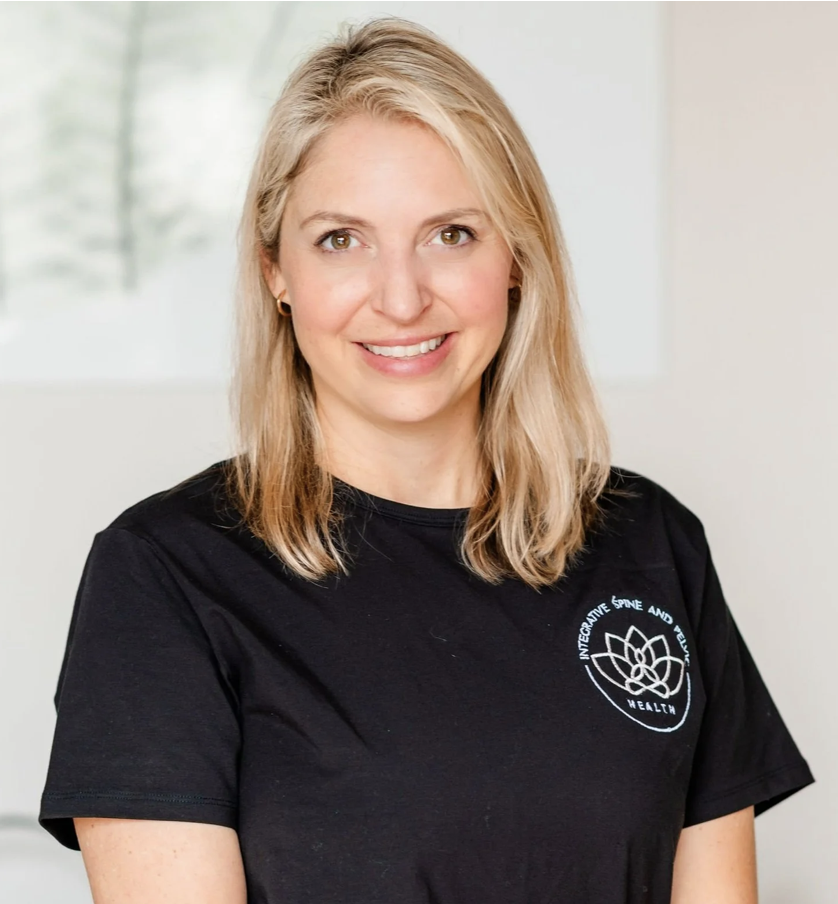
Dr. Lauren Luke is a board-certified orthopedic specialist and women’s health physical therapist whose passion is helping women achieve optimal health and wellness. With over 15 years of experience, Lauren provides integrative pelvic health care for women and girls across the lifespan—from adolescence through menopause. Drawing on her expertise in orthopedics, pelvic health, and whole-body wellness, she blends physical therapy, movement, and mind-body techniques to address everything from pain with sex and bladder issues to birth preparation and recovery, hormonal shifts, and beyond.
Lauren’s leadership extends beyond the clinic—she founded and developed a comprehensive pelvic health and cancer rehabilitation program at a large local hospital, expanding access to specialized care for women navigating complex health journeys.
In addition to her pelvic health expertise, Lauren is a Pregnancy and Postpartum Exercise Specialist (PCES), registered yoga teacher (RYT), and certified in functional nutrition for chronic pelvic pain.
Dedicated to providing the highest level of care, Lauren works closely with each individual to create personalized treatment plans that honor their unique needs and goals. Her compassionate and evidence-based approach has helped countless women restore function, build confidence, and thrive at every stage of life.